Ramsés Fernández
CV
Senior Frontend Engineer — Frontend Architecture

I build micro frontends and the services behind them.

React TypeScript Micro Frontends Design Systems Node.js

Senior Frontend Engineer with 8+ years across travel, banking and consulting. I work mostly on frontend architecture: micro frontends, design systems, and the APIs that connect them to backend services. Most of those decisions affect how several teams work.

Based in
Málaga, Spain
Availability
Open to remote or hybrid roles, EU timezones
Experience
8+ years
Currently
Travelport

Impact metrics

Where I've worked

  • 8+ years in frontend engineering
  • 5 companies — travel, banking, consulting
  • 200+ reusable components shipped at BBVA

RadarFish — shipped solo

  • 7,000+ downloads
  • 5,000+ active users in Spain
  • 4.9★ average across 100+ reviews
§1

Selected work

Two projects where I worked on frontend architecture: Travelport and BBVA.

01 2022 — Present

Travel technology

Travelport via Pasiona

Senior Front-End Developer

Bookings can change after they've already been sold: exchanges, refunds. The existing flow was a single form, and it couldn't handle the different cases.

I own the frontend side of the exchanges and refunds system, from technical design through implementation.

  • Define the frontend architecture in React, TypeScript and Node.js. The UI is split into micro frontends built from plugins, each one talking to a Node.js frontend service over GraphQL.
  • Design those Node.js frontend services — one per plugin, each its own dockerised microservice — and shape the GraphQL contract each micro frontend consumes.
  • Own the frontend CI/CD pipelines on GitHub Actions and Azure DevOps.
  • Instrument frontend and service telemetry with Datadog.
  • Review most of the pull requests on the codebase and mentor junior developers.

React · TypeScript · Node.js · Micro Frontends · GraphQL · .NET · Docker · Kubernetes · Datadog
02 2021 — 2022

Banking

BBVA via SNGULAR

Senior Front-End Developer

Multiple product teams needed a shared frontend foundation, without locking any of them into a single framework.

I co-designed the core frontend architecture used across BBVA's product teams.

  • Built it on Web Components with Lit — any product team could adopt it, regardless of framework.
  • Built the design system and component library on top of it: buttons, forms, tables and other UI primitives, over 200 components in total, that other product teams used directly instead of building their own.
  • Shipped the micro frontends as independently deployable units. Each product team released on its own schedule.

200+ reusable components in the shared library

  • By the time I left, most of BBVA's product teams were using it in production.
  • Reviewed pull requests from multiple engineering teams on the shared codebase, mainly for architectural consistency and accessibility.

Web Components · Lit · Micro Frontends · Design Systems · Accessibility

§2

RadarFish

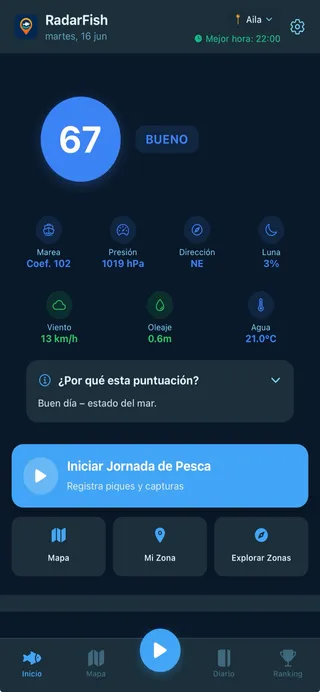
My own product, outside client work. I built the frontend, the backend and both store releases, and shipped all of it myself.

Personal project

RadarFish

A fishing-forecast app I built and shipped by myself.

  • 7,000+ downloads
  • 5,000+ active users in Spain
  • 4.9★ average across 100+ reviews
Scope

I designed the product, the scoring model, the data pipeline and both client apps, then built and shipped all of it myself.

Client
React Native app built with Expo (SDK 54, Expo Router), shipped to both stores through EAS Build. State is handled with Zustand and TanStack Query. The interface is localised in Spanish and English.
Backend
Node.js / Express service on top of PostgreSQL, running the scoring engine that combines marine, weather, tide and solunar data into a per-zone, per-hour score. Deployed on Railway.
Distribution
Freemium, monetised through Apple and Google Play in-app billing. I handle versioning, store submission and staged rollouts myself on both platforms.
Marketing site & API
There's also a companion marketing site (Next.js, ES/EN) and an early B2B API that exposes the same scoring data to outside consumers. Both share the same backend instead of running their own copy of it.
Fishing score, by zone and hour
§3

How the pieces are split up

Two examples of how I approach frontend architecture: independent micro frontends at BBVA, and a frontend layer separated from backend services at Travelport.

A BBVA, 2021 — 2022

Independently deployable micro frontends

Product team A own release cycle
Product team B own release cycle
Product team C own release cycle
Shared frontend architecture Web Components (Lit) · design system · 200+ components

Each team above deploys on its own schedule. What they share is the layer underneath: the design system and the Web Components it's built from. I reviewed pull requests across teams to keep that consistent.

B Travelport, 2022 — Present

Frontend services, decoupled from the backend

PluginPluginPlugin

Micro frontends — React / TypeScript, one per feature

Node.js serviceNode.js serviceNode.js service

Frontend services (BFF) — Dockerised, one per plugin, owned by the frontend team

.NET service.NET service.NET service

Backend services — Owned by backend teams

A plugin on the React side has its own Node.js service behind it, and that service talks to its own slice of the .NET backend. I own the micro frontends and the Node.js services in front of them — both run on Docker and Kubernetes — and I design the GraphQL contract between them. Datadog covers both layers. Regressions usually show up there before anyone opens a support ticket.

C

Stack, by how it gets used

01 Frontend
React · TypeScript · React Native · Angular
The tools I use for product UI, on both enterprise web apps and a shipped mobile app.
02 Frontend Architecture
Micro Frontends · Web Components (Lit) · Design Systems
Shared frontend foundations used by other teams.
03 Backend & APIs
Node.js · REST · GraphQL · Microservices
Connects the UI to containerised services running on the backend.
04 Infrastructure & Delivery
Docker · Kubernetes · CI/CD · Datadog
How frontend code gets built, shipped and monitored once it's live.
§4

Earlier

2018 to now: five companies, moving from full-stack development into frontend architecture.

  1. 2018–2019 Rocketfy Full-Stack Developer
  2. 2019–2020 DEKRA Front-End Developer
  3. 2020–2021 PwC Front-End Developer
  4. 2021–2022 BBVA Senior Front-End Developer
  5. 2022–Present Travelport Senior Front-End Developer
  1. Full-stack JavaScript frontend, Node.js backend, one small team.
  2. Frontend engineering Product UI in React and TypeScript, on regulated, international teams.
  3. Frontend architecture Design systems, micro frontends, and the API layer connecting them.
Detail
  • Apr 2020 — Jan 2021 Front-End Developer · PwC Built and maintained frontend features for a project management app in React and TypeScript. The team was international and worked in English.
  • Jun 2019 — Apr 2020 Front-End Developer · DEKRA Developed frontend features for a medical project management app, in a regulated industry.
  • Jun 2018 — Jun 2019 Full-Stack Developer · Rocketfy Full-stack work: JavaScript frontend, Node.js backend, on a small team. I owned my modules from design through release.
Also
Certification

Certified SAFe 5 Practitioner (2022)

Education

Higher Technician in Web Application Development (DAW), IES Politécnico Jesús Marín (2016 — 2018)

Spanish higher vocational qualification (EQF Level 5), roughly equivalent to a US associate degree.

Languages

Spanish — Native · English — Fluent

§5
Portrait of Ramsés Fernández

About

I've worked at five companies so far: Travelport, BBVA, PwC, DEKRA and Rocketfy, in travel, banking, consulting, healthcare tech and one early-stage startup. Each one needed something different, but I kept ending up doing the same kind of work: shared frontend architecture.

Most of what I do now is deciding where things belong: where one micro frontend ends and another team's begins, where the UI stops and the API connection starts, what goes into the shared design system and what stays specific to one product.

Outside client work, I built RadarFish on my own: product, UI, backend, both app-store releases. Building it alone is probably the best test I've had of my own technical decisions.

§6

Get in touch.

Currently at Travelport.